
 Agroecology Is Not New to Us
Agroecology Is Not New to Us
Klik Untuk Lebih Jelas : Agroecology Is Not New to Us
Klik Untuk Lebih Jelas : Agroecology Is Not New to Us
Klik Untuk Lebih Jelas : Agroecology Is Not New to Us
Klik Untuk Lebih Jelas : Agroecology Is Not New to Us
Reclaiming Dayak Ecological Wisdom for Food Sovereignty and a Living Future
By Sani Lake, JPIC Kalimantan
A seed is never merely a seed.
Within it lives the memory of soil, rain, drought, harvest, hunger, celebration, and care. It carries the patient work of those who selected it, planted it, protected it, and passed it from one season to the next. A seed also contains a promise: that another family may eat, another field may grow, and another generation may still know how to cultivate life.
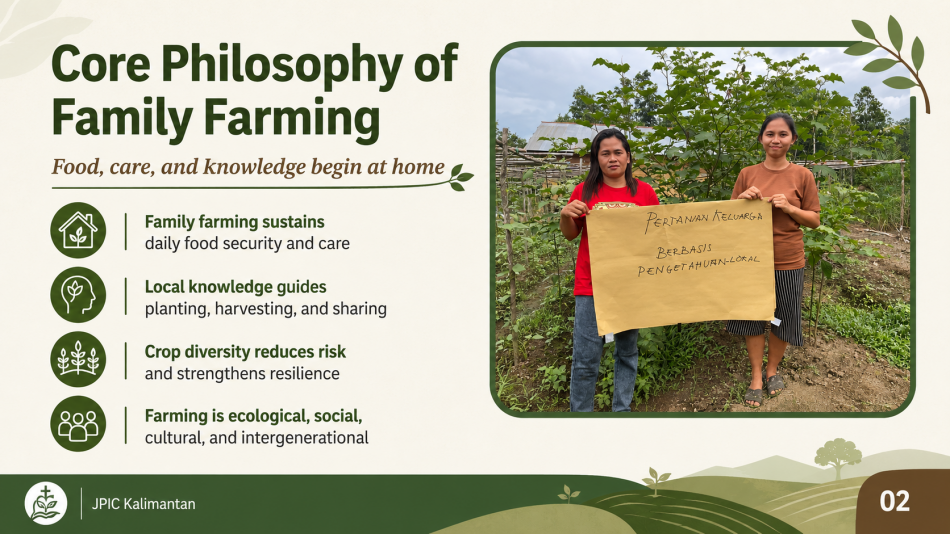
For many Dayak communities in Central Kalimantan, food has never been separated from land, forests, rivers, culture, and relationships. Farming is not simply an economic activity. It is connected to memory, collective labour, customary knowledge, spiritual meaning, and responsibility toward the wider community of life.
Yet these relationships are under growing pressure.
Extractive industries, land conversion, deforestation, forest and land fires, climate disruption, and the weakening of local food systems have increased ecological, social, and economic vulnerability. These changes reduce access to land and sources of livelihood, while also affecting food diversity, traditional farming practices, local seed availability, and the transmission of knowledge between generations.
The crisis, therefore, is not only about declining harvests or damaged landscapes. It is also about the gradual erosion of a way of knowing the world.
This is why agroecology matters.
But for us, agroecology is not a new idea arriving from outside. It is not a technical package waiting to be delivered to communities. Many of its foundations have long been present in Dayak life: shifting cultivation adapted to local conditions, forest-based agroforestry, mixed gardens, multi-layer farming, local seed conservation, forest foods, medicinal plants, collective work, and knowledge of soil, water, seasons, and biodiversity.
The task before us is not to import agroecology. It is to reconnect what has been fragmented, strengthen what still survives, and create the conditions in which Dayak ecological wisdom can continue to grow.
Agroecology as a Living Culture
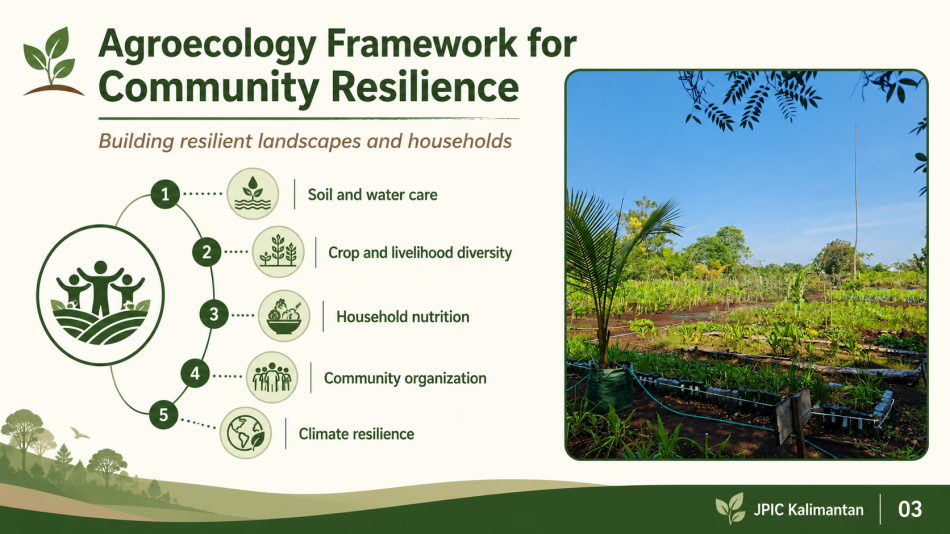
Agroecology is often described as an approach to farming that works with ecological processes rather than against them. It values diversity, recycling, resilience, efficiency, knowledge-sharing, human and social values, and responsible governance. These elements are interdependent; none can be treated as a stand-alone technique.
This wider understanding is important.
Replacing chemical fertilizer with compost may be useful, but that change alone does not constitute transformation. Planting several crops together may improve biodiversity, yet agroecology becomes shallow when it ignores power, land rights, household economics, cultural identity, and community decision-making.
Within the Dayak context, agroecology must be understood as a living culture: a way of relating to nature, a form of collective responsibility, a source of identity, and a pathway toward ecological justice.
Land, forests, rivers, seeds, food, and community life cannot be separated into isolated sectors. Damage to one relationship affects the others. In the same way, restoration cannot occur through agriculture alone. Soil recovery must be connected with water protection, biodiversity, nutritious food, local economies, cultural continuity, and social solidarity.
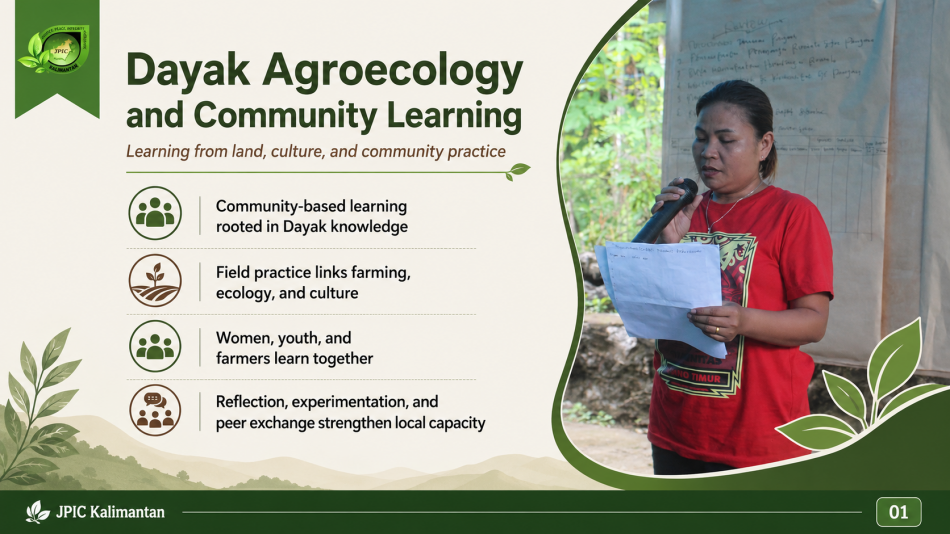
The conceptual framework developed by JPIC Kalimantan therefore places communities at the centre. They are not passive beneficiaries of development programs. They are knowledge holders, decision-makers, experimenters, and the primary actors of transformation.
This position also demands humility from organizations, researchers, governments, and donors. Communities are not empty spaces waiting to be filled with external expertise. Any outside knowledge must enter into respectful dialogue with existing experience.
Science can offer new insights. Global agroecological movements can provide important lessons. Technology may open useful possibilities. But none of these should erase the history, judgment, or agency of the people whose lives are directly tied to the land.
The Crisis Is Also a Crisis of Knowledge
When forests are cleared, more is lost than trees.
Species disappear. Water systems change. Food sources become harder to find. Medicinal plants decline. Seasonal signs become less reliable. Familiar landscapes are transformed into concessions, plantations, mines, roads, or burned areas.
At the same time, younger generations may become increasingly distant from farming. Knowledge that was once transmitted through daily practice can weaken when elders no longer have enough land, time, or opportunity to teach.
Indigenous food systems around the world are deeply connected with traditional knowledge, biodiversity, culture, territorial management, and long-term adaptation to particular ecosystems. FAO’s work on Indigenous Peoples’ food systems likewise emphasizes that their sustainability cannot be understood apart from the knowledge and cultural relationships through which food is produced, gathered, prepared, and shared.
This does not mean that tradition should be frozen or romanticized.
No community remains unchanged. Dayak societies have always responded to new realities. Knowledge develops through observation, adaptation, exchange, and experience. Some practices may need to be reconsidered as ecological conditions shift. Others can be renewed or combined with relevant innovations.
The question is not whether communities should change. The deeper issue is who defines the direction of change, whose knowledge is respected, who bears the risks, and who receives the benefits.
Agroecology becomes transformative when communities are able to answer those questions for themselves.
Ecological Restoration Must Strengthen Livelihoods
One lesson must be stated clearly: ecological recovery cannot be separated from economic dignity.
A farming system cannot be considered transformative if the soil improves while farming families remain trapped in debt, unstable prices, costly inputs, and insecure livelihoods.
This is why agroforestry, mixed gardens, local food production, and organic cultivation should not be treated as ends in themselves. They should help families secure food, reduce production costs, diversify income, manage climate and market risks, and strengthen their position within local economic systems.
The Dayak Agroecology Learning and Practice Center therefore links ecological learning with farm financial literacy. Farmers and community groups need accessible ways to record production expenses, calculate costs and profits, plan cash flow, manage savings, determine fair prices, assess risks, and explore collective marketing.
These are not merely business skills. They are part of the struggle for autonomy.
When farmers do not know the real cost of production, others can easily determine prices for them. When households depend entirely on purchased seeds and external inputs, they become vulnerable to market changes. When crops are sold individually without collective organization, bargaining power remains weak.
Agroecology must therefore strengthen both ecological intelligence and economic capacity.
Diversified farms can produce food for household consumption while also generating income through fruits, spices, forest products, medicinal plants, traditional foods, and processed goods. Women’s groups can develop local products without losing control over their knowledge. Young people can explore new forms of documentation, marketing, and social enterprise while remaining connected to the land.
The goal is not to force every community into the commercial market. Nor is it to turn Indigenous knowledge into a commodity. The purpose is to build livelihoods that are more diverse, dignified, and less dependent on systems that exploit both people and nature.
Seeds Are Memory, Power, and Responsibility
Seed sovereignty lies at the heart of this work.
A community that loses control over its seeds gradually loses part of its ability to determine what it grows, what it eats, and how it responds to ecological change. Commercial seeds may provide certain advantages, but dependence on external suppliers can narrow diversity and weaken locally adapted systems.
Local seeds carry more than genetic material. They embody histories of selection, cultivation, taste, climate adaptation, ritual, and care. Their survival often depends on the quiet and persistent work of farmers, especially women who preserve, exchange, plant, and remember them.
The revised agroecology framework therefore proposes more than small storage facilities. It envisions community seed houses, participatory seed documentation, exchange festivals, living seed gardens, and in-situ multiplication systems. These spaces should remain under community governance, with JPIC Kalimantan serving as a facilitator rather than an owner.
This distinction is fundamental.
The purpose of documenting a seed is not to take it away from the community. Characterization should not become a pathway toward appropriation. Cataloguing must not lead to patenting or commercialization without consent.
Communities must determine what knowledge can be shared publicly, what should remain restricted, and how seeds may be distributed. The rights and authority of seed custodians must remain central.
The international food-sovereignty movement has long argued that agroecology cannot be reduced to production techniques. It is inseparable from the right of peoples to shape their food systems, protect their territories, defend seeds, and control the knowledge on which their survival depends.
For Dayak communities, seed protection is therefore both practical and political. It safeguards biodiversity while also preserving memory and collective power.
Communities Are Not Project Locations
Development programs often begin with prepared activities, fixed indicators, and predetermined outputs. Communities are then invited to participate in plans that have largely been decided elsewhere.
Our approach must move in the opposite direction.
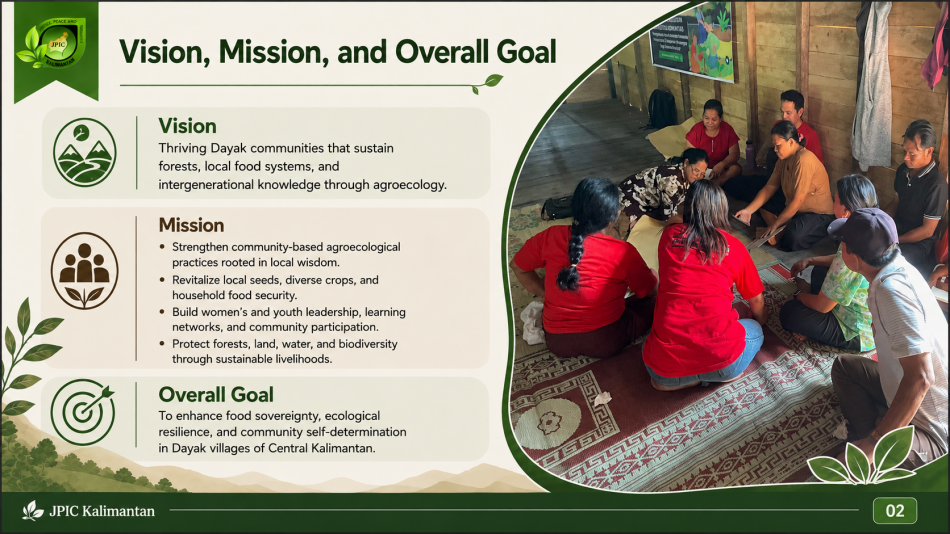
Before technical activities begin, Participatory Action Research should help communities examine their own social and ecological realities. This process may include mapping landscapes, food sources, seed diversity, livelihood conditions, land-use changes, knowledge holders, community institutions, and barriers faced by women, young people, persons with disabilities, or other groups.
The purpose is not simply to collect data for an organization. It is to enable collective understanding and shared decision-making.
Only after communities have identified their priorities, concerns, capacities, and aspirations should activities be designed. Consent must be more than a signature. It requires understanding, dialogue, the ability to disagree, and genuine influence over decisions.
Farmer Field Schools and farmer-to-farmer learning can support this process because they treat fields as places of observation and experimentation. FAO describes Farmer Field Schools as participatory, learning-by-doing spaces that place farmers at the centre of innovation rather than treating them as recipients of instructions.
In each pilot community, a small number of committed lead farmers may receive more intensive accompaniment. Their role is not to become a new elite. They should serve as learning partners who manage demonstration plots, test practices, mentor others, and encourage collective reflection.
Their selection must be transparent. Women and young farmers should be intentionally included. Knowledge should circulate rather than become concentrated in a few hands.
This is the difference between delivering a project and cultivating a movement.
Women and Young People Are Not Secondary Actors
Women are often placed at the centre of food security while remaining at the margins of formal decision-making.
They plant household gardens, preserve seeds, process food, manage nutrition, maintain family economies, and carry knowledge about medicinal plants and local varieties. Yet their labour can remain invisible, while men or institutions are more frequently recognized as agricultural leaders.
A transformative agroecology movement must change this imbalance.
Women should not participate only as beneficiaries of nutrition activities or small enterprises. They must have real authority in seed governance, community planning, economic decisions, training processes, and policy advocacy.
Young people also require more than invitations to attend meetings.
They need meaningful roles as farmers, researchers, storytellers, facilitators, media producers, and innovators. Photography, video, writing, oral-history recording, and digital archives can connect technological skills with ecological memory. Agroecology camps and intergenerational learning can create spaces where elders and young people meet not as symbols of the past and future, but as partners in the present.
The Dayak Agroecology Learning and Practice Center therefore brings together the knowledge of elders, the experience of farmers, the creativity of women, and the capacities of young people. Its long-term purpose is not simply to transfer information, but to regenerate leadership.
From Community Practice to a Wider Movement
Agroecology cannot be expanded simply by multiplying projects.
A model developed in one village should not be copied mechanically into another. Every community has its own history, ecology, institutions, conflicts, knowledge, and aspirations. Expansion must begin again with listening.
A more responsible pathway starts with pilot communities, learning gardens, seed systems, and lead-farmer networks. From there, exchange can grow between villages. Evidence from practice can enter village planning. Partnerships can be developed with district governments, universities, farmers’ organizations, Indigenous networks, faith-based groups, and civil-society movements.
Public communication is also part of this work.
JPIC Kalimantan seeks to share community experiences through its social-media channels and online platforms such as Huma Nusantara and News Way. These spaces can help document agroecological practices, broaden discussion about food sovereignty, and connect local experience with wider public debates.
Within civil-society networks in Palangka Raya and Central Kalimantan, JPIC has also been entrusted with helping to lead and strengthen the agroecology agenda. This responsibility creates an opportunity to connect organizations, communities, researchers, and public institutions around a shared movement for ecological and social transformation.
Such expansion is not measured only by the number of locations reached. It can also be seen in the spread of knowledge, the confidence of farmers, the emergence of local leaders, stronger community organizations, supportive village policies, and a growing public understanding that food systems are inseparable from justice.
A regional learning centre may eventually emerge from this process. But it should not begin as an impressive building without roots.
Its real foundation must be living communities.
Carrying Living Knowledge into the Future
Agroecology is sometimes presented as a return to the past. That description is inadequate.
The future cannot be built by romanticizing earlier times, especially when communities now face new pressures, changing climates, altered landscapes, and economic uncertainty. Yet the future will also remain fragile if it is built by abandoning the knowledge that enabled generations to live within particular ecosystems.
Dayak agroecology is therefore neither a retreat into nostalgia nor an uncritical acceptance of modern agricultural models.
It is a work of discernment.
It asks what must be protected, what should be restored, what needs to change, and what new knowledge can be welcomed without surrendering community control.
It understands that ecological resilience depends on cultural continuity, that food sovereignty requires economic dignity, and that genuine transformation cannot happen without local leadership.
Most importantly, it begins from a simple conviction:
Agroecology is not new to us.
Its language may now appear in international institutions, research centres, and global movements. But its deepest principles—diversity, reciprocity, adaptation, collective responsibility, care for soil and water, respect for seeds, and learning through practice, have long lived within Indigenous communities.
Our task is not to claim that nothing new is needed. It is to ensure that new knowledge enters through dialogue rather than domination.
We are not seeking to bring agroecology to Dayak communities as an external solution. We are working to create spaces where ecological wisdom can be remembered, practised, questioned, renewed, and passed forward.
This is how damaged landscapes may begin to heal.
This is how communities may regain greater control over food and livelihoods.
This is how seeds may continue to carry memory into another season.
And this is how a living future can be cultivated, together